Showing posts with label sylvia plath. Show all posts

Monday, March 31, 2014

Review: Chocolates for Breakfast by Pamela Moore


I always hesitate to say that I loved a book or movie but I think I loved this book.  Just back in print after 50-some years, Chocolates for Breakfast is a sexier version of The Bell Jar and Pamela Moore parallels Sylvia Plath in that she is also a young woman in a rough marriage tortured by depressive bouts and eventual suicide.  Pamela Moore touches on many of the same coming-of-age themes of other young adult favorites like The Catcher in the Rye and The Perks of Being a Wallflower.  In Plathian fashion, Moore killed herself at the age of twenty-six, eight years after Chocolates for Breakfast was first published in 1956.

The risque novel begins with fifteen-year-old Courtney Farrell holding an argument with her boarding school roommate Janet Parker, whose hobbies include lounging in the nude and getting kicked out of schools.  Janet is arguing that Courtney is too involved with one of the female English teachers who tutors the bright and bored Courtney in the evenings.  Janet tells her that the other girls are starting to think Courtney has a crush on Miss Rosen.  Courtney denies it but does seem to find her relationship with Miss Rosen very important, so much that she goes into a depression when Miss Rosen says Courtney is no longer allowed to visit her.  Courtney leaves Scaisbrooke for her actress mother's trendy apartment in Hollywood and then on to New York City where Courtney departs from her childhood quickly.

Reading the book feels as luxurious as the title sounds.  Cocktail parties, dates with older men, and sleeping in til early afternoon fill the novel.  Courtney's life as daughter of an actress mother and a rich father means decadence to the point of surrealism.  What struck me about Chocolates was Moore's voice.  She was seventeen when she wrote it, eighteen when it was published, so Moore was writing in the moment.  She wasn't looking back and remembering how she felt in her transition from child to woman; she was in that change.  She still wasn't sure how everything would end up for her, but she imagines for Courtney a hopeful and happy ending.  Some scenes could be criticized as cheesy and highly romanticized, but I had to smile in appreciation of the too-perfect scenes because that is exactly what a seventeen-year-old girl would write.

There are obviously a great many differences between Chocolates and Bell Jar.  Moore's novel is not told in the first person, and although we are offered a lot of clues about what Courtney and occasionally other characters are thinking, it is certainly not the "I just stepped into the mind of a crazy girl" experience that Plath gives a reader.  Whereas Plath is very raw in her descriptions of depression and suicidal thoughts, Moore romanticizes such things right alongside love affairs, champagne for breakfast, and fancy dinners.  With Esther in The Bell Jar the reader feels as though she knows what led Esther to want death.  With the characters in Chocolates for Breakfast, we are only looking in on their oversexed, scotch-drenched teenage lives and can only guess what they are truly feeling.

For reasons unexplained to myself, I loved this book.  Maybe it's because the review where I learned of it billed Chocolates as a lost classic, and I was eager to be a first to appreciate it in its rediscovery.  Maybe I just love the sound of chocolate.  Or maybe I have a fascination with coming-of-age stories. Whatever the reason, if you loved The Bell Jar you will love Moore too.

Monday, November 4, 2013

Review: The Bell Jar by Sylvia Plath

            It is1953, the summer before Esther’s senior year as an English honors student at an Ivy League all-girls’ college.  She, as a skilled poet, artful writer, and top student, earns a month-long summer internship for a young ladies’ magazine in New York City.  It seems that Esther has everything going for her: a prestigious scholarship to a top college, a medical school beau, and a glittering internship.  In NYC, however, questions arise within Esther that she cannot answer, daunting questions about her future, her life after the internship, after the summer, after graduation.  They begin to eat away at her spirit and morale.  She could marry someone, perhaps Buddy Willard the med student, and clean his house, have his babies, and make his dinners.  Or she could pursue any number of professional interests such as author, professor, editor, or explorer.  She is frustrated that she must choose only one and give up the other option.  Her inability to choose one direction and forget the rest is a source of crippling anxiety.  The uncertainty of her own future terrifies this over-achieving young woman.  When Esther returns home from New York to await the start of the fall semester, her anxiety turns to apathy before spiraling into a deep and destructive depression.


            The reason this highly personal, highly autobiographical novel is viewed as more than a lost college girl’s diary entries written almost 20 years later is obvious.  Along with touching on themes of purity and sexuality, the feminist classic is a clear portrait of the tough choices young women faced not just in the 50s but for the past 60 or 70 years.  Any girl at a crossroads in her life would be struck by Plath’s ability to pinpoint the reader’s own personal fears about innocence, sexuality, marriage, education, and careers through Esther’s story.  The feminist struggle between family and career are debated from the perspective of someone with the beginning of this struggle on her horizon.

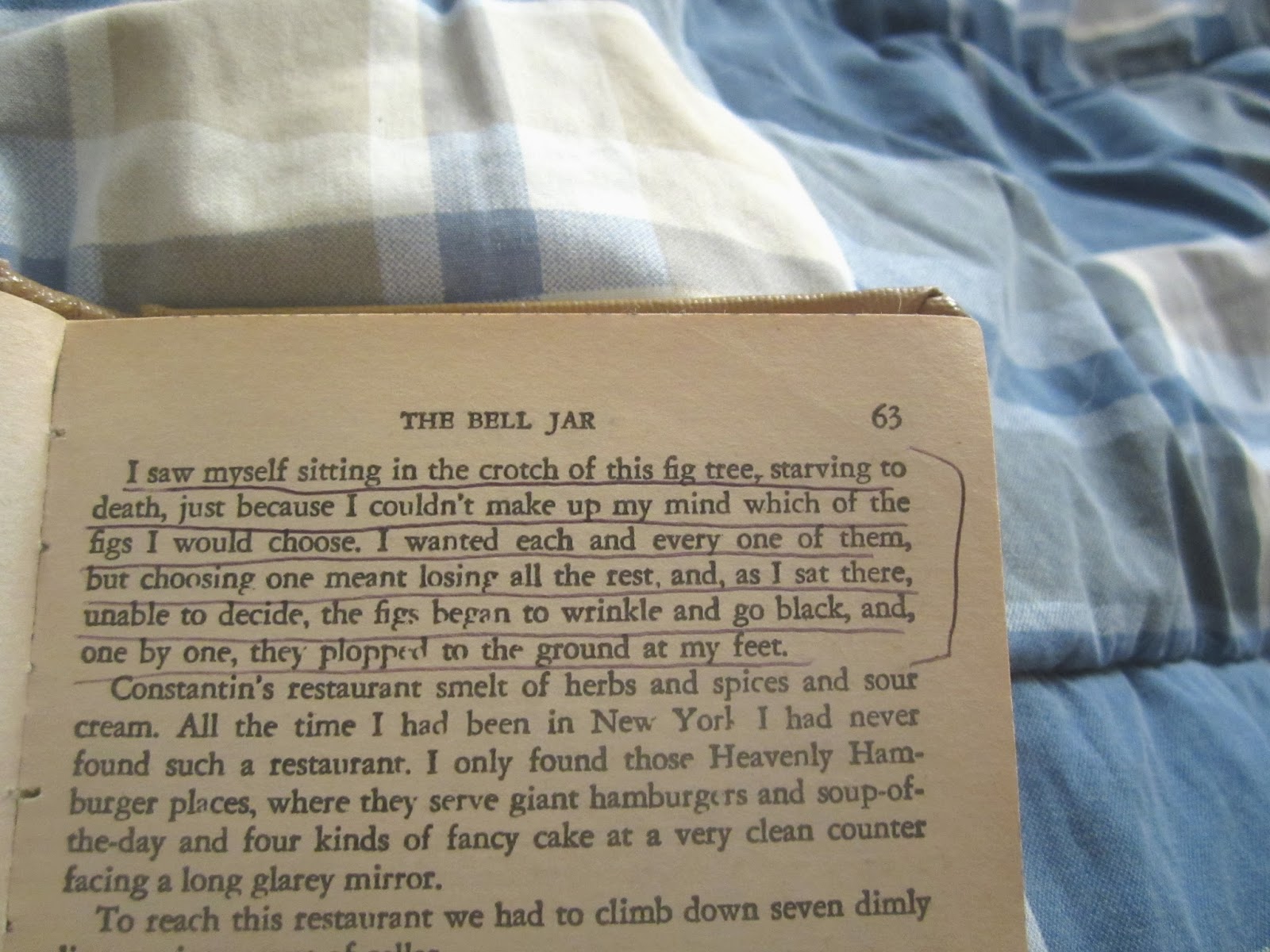
            One passage that exposes the stress college and even high school girls felt 60 years ago and still feel today gripped me with its imagery and its relativity to my own life.  Esther says she sees her life branching out like a fig tree, and each fig is a different future she could pluck and bite into.

For the record, I did not mark in this library book! :) The passage had already been underlined.  What kind of library worker would I be if I wrote in borrowed books?

            The fig tree appears earlier in the novel when Esther opens an anthology of short stories to find one about a Jewish man and a Catholic nun meeting under a fig tree.  The fig tree in the Bible is said to symbol prosperity, security, and peace, which are things Esther longs for, but she doesn't know which fig seems best suited to bring her happy security.

           Sylvia Plath’s novel and writing style is blunt and haunting.  I read it over the summer, which turned out to be long, dull, and lonely for me, so I was a bit frightened when the beginning of the novel truly resonated with me.  Esther starts at sad and confused and slides along the depression continuum.  Further into the book when I found I no longer shared her same thoughts or agreed with her plans to hurt herself, relief spread through me.  I’m not sure if I would recommend this book  as a remedy for depressive moods, but it did show me that I wasn’t alone in my helpless frustration and indecision.  While I appreciated the novel's strong themes of purity and awakened sexuality and could talk about them for ages and pages, the idea that stays with me months later is the fig tree.  The Bell Jar and its fig tree imagery gave me strange comfort and even while it left me haunted and intrigued by Plath and her own tumultuous life.

Have you read The Bell Jar?  Did you like it?  How did it affect you?