Showing posts with label gender roles. Show all posts
Thursday, April 16, 2015
Review: The Girl on the Train by Paula Hawkins
Rachel Watson takes the train into London every day, sits in the same compartment, stops at the same train signals, and observes the same trackside houses at these daily standstills. One in particular holds her attention because it holds what Rachel imagines to be the perfect couple. For a year she sees them through her compartment window several times a week. She watches them out on their back terrace living life as though unnoticed, drinking coffee or wine, talking or holding hands. Rachel constructs a narrative for them by piecing together the style of clothing she sees them wearing, the body language she observes, and most importantly, the life and marriage she feels she used to have. She projects on her almost fictitious couple the idealized, sunshiny life she has longed for since her divorce. One day Rachel observes something at her idyllic couple's house that jars her and then intertwines her in a thrilling mystery when the wife goes missing the very next day.
The idea of feeling connected to people you've never met simply because you have a rear window glimpse into their lives is a story seed that would make Alfred Hitchcock proud. The main narrator Rachel is more than just a passive onlooker or busybody, however. This character's alcoholic tendencies are worthy of Stephen King's praise, and together with her persistent love for her ex-husband, Rachel dumps a lot of her own baggage into this unsolved case. To hide her drinking problem and its consequences, Rachel has become used to telling lies, but the missing woman, who is a secondary narrator, has many secrets and lies of her own.
Without spoiling anything, I want to comment on the feminism of The Girl on the Train. The message on traditional gender roles is subtle at first but eventually comes forward as an important final note. Throughout the novel, Hawkins' female characters all see their worth through the eyes of men. As the story comes to a close, though, they all seem to find some level of personal strength to do what they know they have to do. In confronting their individual fears of rejection in some form, they take one firm step towards emancipating themselves from the destructively limiting gender roles which they had previously fully accepted. (Come back to this after reading it, and hopefully it will make sense.)
The Girl on the Train is for the Gone Girl fanatic and adversary alike. As someone who only saw the film adaptation of Gone Girl without reading the book, I have placed myself squarely in the second- and unpopular- camp of people disappointed with Gone Girl. The movie version of Gillian Flynn's thriller had an interesting plot set-up but it was littered with inhuman, unrealistic characters that I found confusing and frustrating. The Girl on the Train deals with similar themes of trust and envy within marriages but does so through believable motives maintained by flawed and fallible characters. Both thrillers tell stories of wildly imperfect people but Hawkins manages to keep her female characters relatably, sympatheticly human.
In short, The Girl on the Train is absolutely craveable. From the very first page, the pacing of the thriller is impeccably timed. Hawkins feeds the reader a juicy new detail at exactly the right time and just when that bit has started to digest, the next exciting little piece of information is presented. Be prepared to forego all responsibilities until this book is finished, and then be prepared to scour bookshelves for something similar to fill the new void.
Tuesday, December 30, 2014
Defining Feminism
Feminism is making a comeback. It's especially talked about on social media, so much so that #womenagainstfeminsim has cropped up as well. I know feminism is truly awakening from its 1990s-2000s slumber if there is a sizable reaction against that movement. So in fact, I'm pretty thankful for these anti-feminist tweets and opinions because it means people are noticing a rise in support for feminism and want to discuss it.
At first I was really upset by the tweets and YouTube videos I found after searching #womenagainstfeminism on Twitter and Google a few months ago. In fact, this post was going to be a bit angry and argumentative. After talking to my very wise friend Megan, though, I realized that that is exactly what I don't need to contribute to the conversation. I think most of these women already know that without feminism they couldn't be doing what they are doing today (vote, own property, divorce, show some ankle, etc.). While I disagree with most of the women against feminism, I am most upset by the fact that this tweet debate shows that nobody really knows what feminism is. Feminists don't even really know. They argue about the definition and what it means to live your life as a feminist pretty much constantly. Does a woman have to throw away her razor and skirts to be considered a feminist? If a woman is a stay-at-home mom, is she a feminist? If a woman is a stripper, can she be included as a feminist? What are feminists fighting for, exactly? Whose rights? American women? [Insert race here] women? Lower-class women? Fat women? Transwomen?
While mulling this over, the terrible and wonderful my-professor-was-right-all-along hit me. In a feminist criticism course I took, the professor spent a lengthy amount of time discussing the relativity of feminism to modern women and if it can even be defined anymore. After all, there isn't one single and obvious reform to rally around like suffrage or even the Equal Rights Amendment. We discussed whether something needs a hard and fast definition to even exist. We talked about the severe negativity many people associate with "the other F word." We speculated that perhaps adopting a word like "equalist" would be a safer, more comfortable label. I disagreed with her at the time, thinking "equalist" was wimping out and making "feminist" even more of a "bad word". I thought the prof was suggesting that feminism as an active movement had come to a close and now all we could do was exchange high-fives and critique old literary pieces using historic, archaic feminist ideas.
Now my own internal feminist debate that has been storming most ardently in the past few weeks has come full circle and I find myself again looking at the ideas in Dr. C's feminist criticism class. Although now I feel I can see a bit more clearly into the murky, muddy puddle that is feminist theory. We need a definition of feminism. But who is authorized to give it?
A while ago I watched a TED talk given by Tavi Gevinson that grappled with the same issues. The precocious high school girl, who runs a fashion blog and considers herself a feminist, explains how she came to terms with all the contradictions that come with being a feminist, not to mention one obsessed with fashion. Feminism is incredibly complex and means something different to virtually every person who has encountered the word. So basically, you must define it for yourself. I know. That clears up very little. But I'll try to explain by giving my personal definition and some guidelines about finding your own feminism.
My definition of feminism is "total equality regardless of gender identification or sexual orientation". The way I measure this "equality" is based on the abolition of the assumption that we as humans possess any ownership over another human's body. Societal expression of this ownership assumption includes rape and sexual assault, body judgement and shame, oversexualization of the female (or male) body in media, and in other parts of the world women are still trying to declare freedom from body ownership in serious and basic ways, like genital mutilation and prearranged marriages that equate to goods exchanges. The second part of my definition is compassion. I know that a lot of women give back the hate they feel directed at them and call it feminism, but I don't subscribe to that. Compassion is the motivation for my feminism. The third part of my definition is that all women should be free to choose their own life. If they want to be mothers, they should be. If they want to chase a career, they should. If they want to do both, they should be able to without judgments made on their parenting. If they want to stay home and homeschool their kids and bake pies and sew clothes, they should be able to without judgment.
My guidelines for defining feminism are simple. Equality should be in your definition somewhere. Hatred should be left out of equal rights fights always. And feminism is not exclusive. It can't fully exist without also fighting racism and classism. It also intersects with gender spectrum issues and fat studies these days.
Sounds really idealistic, romantic, and other words for the opposite of realistic. But that's the thing. I want it to become a reality.
Wednesday, October 8, 2014
Review: Like Water for Chocolate by Laura Esquivel
Like Water for Chocolate is a Mexican love story about Tita de la Garza and her family. Tita has a great talent for cooking all of her family's recipes perfectly. She also possesses a magical power that adds her emotions to her dishes if she is feeling a particularly strong sentiment while preparing that meal. The people who enjoy her dish then feel the same strong emotion, be it lust, anger, sadness, or joy. Tita has no control over this power and only seems half-aware of it, which gets her into a lot of complicated situations with her family members.
Like Water for Chocolate is told in twelve monthly installments, with a pertinent traditional recipe preceding each chapter. Esquivel's style is folklore frank and matter-of-fact, even when the facts of the matter involve crazy magical realism such as a chicken tornado (it's exactly what it sounds like) and death by spectacular causes (which I won't spoil for you). As with most folk stories, it is sometimes bizarre, sometimes hilarious, sometimes heartbreaking.
A while ago I found this BuzzFeed list (love BuzzFeed book lists!). As I was looking through these awesome titles, I started to realize that Like Water for Chocolate could easily have been on this list. It has some of the same components as the list's other books that have sparked someone's "feminist awakening." Like Water for Chocolate is totally focused on the women of the de la Garza family. Tita's Mama Elena has been head of the house since Tita's father died, and Mama Elena only has daughters, making their house and ranch and story very femme-centric. All the main characters are women: women obeying other women, learning from other women, helping each other, fighting each other for supplementary, passive male love-interest characters. While civil war Mexico was undoubtedly a patriarchal society, Like Water for Chocolate demonstrates how war has often pulled countries away from domestic patriarchy to literal matriarchy.
Like Water for Chocolate also explores female sexuality, highlighting the women's desires more than their male lovers. Apart from this feminist-approved treatment of sexuality, this bittersweet tale boasts female characters that take charge of their own futures. At first Tita tries to follow tradition even though it causes her pain, separating her from her beloved Pedro. Eventually she throws tradition to the wind and goes after what she wants. Tita's sister Gretrudis, who runs away from home to chase a handsome soldier after eating a delicious meal made by Tita that happened to be drenched in lust, becomes a general in the Mexican army, so it's not just domestic life that doesn't adhere strictly to traditional gender roles in Esquivel's tale.
Whether you're into feminist awakenings or not, you should definitely read Like Water for Chocolate, particularly if you're into any of the following: Mexican food, sexual tension, crazy mothers, sister rivalry, magical cooking powers, chicken tornadoes, ghosts, interesting deaths, or everlasting love. And if none of that interests you, I'm not sure what type of friendship we could have.
Wednesday, May 21, 2014
Review: The Lowland by Jhumpa Lahiri
I have not read any of Jhumpa Lahiri's works before, but I had heard goods things about them from various readers, and I noticed several copies of The Lowland on hold at my workplace, an academic library. I also saw that it had been mentioned in the New York Times Book Review. This led me to believe I would be reading an important contemporary novel of significant value that would in some way or another enrich my literary life. I'm not going to sugar-coat it; this book was a terrible disappointment for me.
Subhash and Udayan are very close brothers who grew up together in Calcutta in the 1960s, when that part of India was rocked with a rebellion movement. Udayan, the younger brother by less than a year, is secretly involved in this violent revolutionary attempt, looking to Mao and Che Guevara for inspiration. Subhash is an academic who goes to the United States to pursue doctoral studies in environmental chemistry. Shortly after Udayan marries the lonely and philosophical Gauri without his parents' permission, the rebellion swallows him. His parents, brother, and wife, four family members who are so isolated from one another geographically or emotionally that they are almost strangers, must learn to exist without their beloved son, almost-twin, and soulmate. Strong themes of isolation and regret fill the pages with little to no forgiveness and love to balance.
The main problem with The Lowland is that nothing happens and it takes a long time to do it. Lahiri sets up a wonderful story that has so much potential, but just when you think the plot begins to climb to an exciting level of complexity, it falls flat and remains at that plateau for the characters' entire stories. I love Irish literature, so I'm always up for a good, devastatingly sad story, but The Lowland is not that. It has one heartbreaking event that the characters languish in, refusing to heal and evolve in their mourning. Other scenes had the latency to be deliciously sad, but their muted sentimentality left them completely anticlimactic. The characters all make very interesting life choices, but the author fails to satisfactorily explore their motives and emotions. The back of the cover promised "shimmering" writing with "uncommon elegance." I was totally unimpressed with Lahiri's writing. Of course it was written well enough, but not a single phrase struck me with its beauty, no analogy swept me away with any sort of originality.
In her discussion of the book, Emma of A Beautiful Mess suggests that Gauri is an example of "feminism gone wrong." I assume she means Gauri used the freedom feminism advocates for evil or that she took advantage of her freedom to do "wrong" things. While I really dislike the phrase "feminism gone wrong" to describe this character's actions, in some regards I agree with Emma. Gauri could represent the past and present fear of women with passions for their careers and the belief that these women are selfish and slightly monstrous. Almost everything Gauri does after Udayan dies is self-serving and loveless. Traditional female roles do not suit her; her one lasting passion is studying philosophy. Gauri could be a cautionary tale of career women who reject family by allowing a purpose outside the family unit to overtake their traditional responsibilities, thus destroying the lives of all the family involved. While I agree that Gauri could be a representation of this fear of feminism, her story is not the reality of most passionate career women in real life, and it is no fault of feminism that Gauri had the opportunities to be so selfish.
Have you read The Lowland? What did you think?
Sunday, April 6, 2014
Feminist Critique: Hozier "Cherry Wine"
I am in love. His name is Hozier and he's an artist. His voice is a smooth shot of rich espresso. His lyrics, coupled with an acoustic and soulful sound, summon a deep spirituality. His poetic lyrics describe women as powerful and not in the typical femme fatale way. Hozier's songs talk about women as ethereal creatures with worshipful wonder and helplessness. While he uses Biblical references in almost every song, it's as if woman is his deity.
I know you're thinking to yourself, but Julie, isn't worshiping women just another form of objectifying them? Doesn't that mean Hozier is still refusing to see women as his equal? And I would have to answer, yes, you're probably right. But pipe down. You're ruining a perfectly nice song. :) I also think that there is more to the songs than simple objectification since Hozier does not expound on a woman's beauty and sex appeal but of her mystery and powers. If that does not reassure you, at least there is no disrespect toward women in any of his songs.
His song Cherry Wine even has some traditional gender role reversal, which is how I knew our love was real.
The narrator is in an abusive relationship, and the lyrics are clearly talking about physical signs of abuse, but these could be metaphorical for the emotional bruising taking place. Either way, the narrator holds no anger, forgives freely, and remains devoted and submissive to this destructive woman. I'm definitely not advocating husband-beating, but I still find the role reversal intriguing.
Enjoy this song and check out his others! I'd love to hear your opinions of Hozier as an artist and his lyrics in relation to feminism.
Cherry Wine ~ Hozier
Her eyes and words are so icy
Oh but she burns
Like rum on the fire
Hot and fast and angry
As she can be
I walk my days on a wire.
It looks ugly, but it's clean.
Oh mama, don't fuss over me.
The way she tells me I'm hers and she is mine
Open hand or closed fist would be fine.
The blood is rare and sweet as cherry wine.
Calls of guilty fall on me
All while she stains
The sheets of some other
Thrown at me so powerfully
Just like she throws with the arm of her brother.
But I want it, it's a crime
That she's not around most of the time.
The way she shows me I'm hers and she is mine
Open hand or closed fist would be fine
Blood is rare and sweet as cherry wine.
Her fight and fury is fiery
Oh but she loves
Like sleep to the freezing
Sweet and right and merciful
I'm all but washed
In the tide of her breathing.
And it's worth it, it's divine
I have this some of the time.
The way she shows me I'm hers and she is mine
Open hand or closed fist would be fine
The blood is rare and sweet as cherry wine
I know you're thinking to yourself, but Julie, isn't worshiping women just another form of objectifying them? Doesn't that mean Hozier is still refusing to see women as his equal? And I would have to answer, yes, you're probably right. But pipe down. You're ruining a perfectly nice song. :) I also think that there is more to the songs than simple objectification since Hozier does not expound on a woman's beauty and sex appeal but of her mystery and powers. If that does not reassure you, at least there is no disrespect toward women in any of his songs.
His song Cherry Wine even has some traditional gender role reversal, which is how I knew our love was real.
The narrator is in an abusive relationship, and the lyrics are clearly talking about physical signs of abuse, but these could be metaphorical for the emotional bruising taking place. Either way, the narrator holds no anger, forgives freely, and remains devoted and submissive to this destructive woman. I'm definitely not advocating husband-beating, but I still find the role reversal intriguing.
Enjoy this song and check out his others! I'd love to hear your opinions of Hozier as an artist and his lyrics in relation to feminism.
Cherry Wine ~ Hozier
Her eyes and words are so icy
Oh but she burns
Like rum on the fire
Hot and fast and angry
As she can be
I walk my days on a wire.
It looks ugly, but it's clean.
Oh mama, don't fuss over me.
The way she tells me I'm hers and she is mine
Open hand or closed fist would be fine.
The blood is rare and sweet as cherry wine.
Calls of guilty fall on me
All while she stains
The sheets of some other
Thrown at me so powerfully
Just like she throws with the arm of her brother.
But I want it, it's a crime
That she's not around most of the time.
The way she shows me I'm hers and she is mine
Open hand or closed fist would be fine
Blood is rare and sweet as cherry wine.
Her fight and fury is fiery
Oh but she loves
Like sleep to the freezing
Sweet and right and merciful
I'm all but washed
In the tide of her breathing.
And it's worth it, it's divine
I have this some of the time.
The way she shows me I'm hers and she is mine
Open hand or closed fist would be fine
The blood is rare and sweet as cherry wine
Monday, November 4, 2013
Review: The Bell Jar by Sylvia Plath
It is1953,
the summer before Esther’s senior year as an English honors student at an Ivy
League all-girls’ college. She, as a
skilled poet, artful writer, and top student, earns a month-long summer
internship for a young ladies’ magazine in New York City. It seems that Esther has everything going for
her: a prestigious scholarship to a top college, a medical school beau, and a
glittering internship. In NYC, however,
questions arise within Esther that she cannot answer, daunting questions about
her future, her life after the internship, after the summer, after graduation. They begin to eat away at her spirit and
morale. She could marry someone, perhaps
Buddy Willard the med student, and clean his house, have his babies, and make
his dinners. Or she could pursue any
number of professional interests such as author, professor, editor, or
explorer. She is frustrated that she must
choose only one and give up the other option. Her inability to choose one direction and
forget the rest is a source of crippling anxiety. The uncertainty of her own future terrifies
this over-achieving young woman. When
Esther returns home from New York to await the start of the fall semester, her
anxiety turns to apathy before spiraling into a deep and destructive depression.
The reason
this highly personal, highly autobiographical novel is viewed as more than a lost
college girl’s diary entries written almost 20 years later is obvious. Along with touching on themes of purity and
sexuality, the feminist classic is a clear portrait of the tough choices young
women faced not just in the 50s but for the past 60 or 70 years. Any girl at a crossroads in her life would be
struck by Plath’s ability to pinpoint the reader’s own personal fears about innocence,
sexuality, marriage, education, and careers through Esther’s story. The feminist struggle between family and career
are debated from the perspective of someone with the beginning of this struggle
on her horizon.
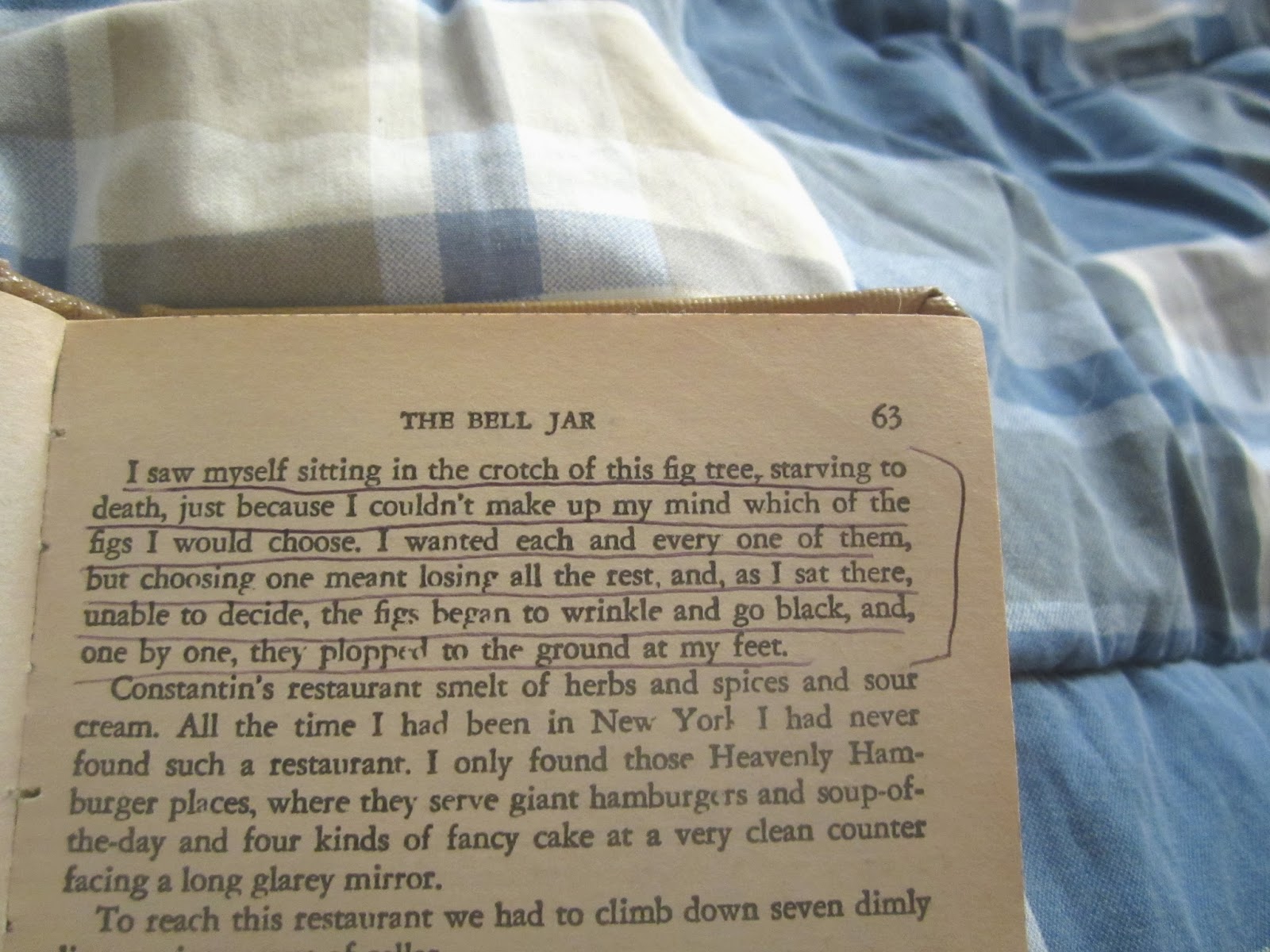
One passage
that exposes the stress college and even high school girls felt 60 years ago
and still feel today gripped me with its imagery and its relativity to my own
life. Esther says she sees her life
branching out like a fig tree, and each fig is a different future she could
pluck and bite into.
| For the record, I did not mark in this library book! :) The passage had already been underlined. What kind of library worker would I be if I wrote in borrowed books? |
The fig
tree appears earlier in the novel when Esther opens an anthology of short
stories to find one about a Jewish man and a Catholic nun meeting under a fig
tree. The fig tree in the Bible is said
to symbol prosperity, security, and peace, which are things Esther longs for, but
she doesn't know which fig seems best suited to bring her happy security.
Sylvia
Plath’s novel and writing style is blunt and haunting. I
read it over the summer, which turned out to be long, dull, and lonely for me,
so I was a bit frightened when the beginning of the novel truly resonated with
me. Esther starts at sad and confused
and slides along the depression continuum. Further into the book when I found I no longer shared her same thoughts or agreed with her plans to hurt herself, relief spread through me. I’m not
sure if I would recommend this book as a remedy for depressive moods, but it did show me that I wasn’t alone in my helpless frustration and indecision. While I appreciated the novel's strong themes
of purity and awakened sexuality and could talk about them for ages and pages,
the idea that stays with me months later is the fig tree. The Bell Jar and its fig tree imagery gave me strange
comfort and even while it left me haunted and intrigued by Plath and her own tumultuous
life.
Have you read The Bell Jar? Did you like it? How did it affect you?
Subscribe to:
Posts (Atom)