Showing posts with label book review. Show all posts
Thursday, April 16, 2015
Review: The Girl on the Train by Paula Hawkins
Rachel Watson takes the train into London every day, sits in the same compartment, stops at the same train signals, and observes the same trackside houses at these daily standstills. One in particular holds her attention because it holds what Rachel imagines to be the perfect couple. For a year she sees them through her compartment window several times a week. She watches them out on their back terrace living life as though unnoticed, drinking coffee or wine, talking or holding hands. Rachel constructs a narrative for them by piecing together the style of clothing she sees them wearing, the body language she observes, and most importantly, the life and marriage she feels she used to have. She projects on her almost fictitious couple the idealized, sunshiny life she has longed for since her divorce. One day Rachel observes something at her idyllic couple's house that jars her and then intertwines her in a thrilling mystery when the wife goes missing the very next day.
The idea of feeling connected to people you've never met simply because you have a rear window glimpse into their lives is a story seed that would make Alfred Hitchcock proud. The main narrator Rachel is more than just a passive onlooker or busybody, however. This character's alcoholic tendencies are worthy of Stephen King's praise, and together with her persistent love for her ex-husband, Rachel dumps a lot of her own baggage into this unsolved case. To hide her drinking problem and its consequences, Rachel has become used to telling lies, but the missing woman, who is a secondary narrator, has many secrets and lies of her own.
Without spoiling anything, I want to comment on the feminism of The Girl on the Train. The message on traditional gender roles is subtle at first but eventually comes forward as an important final note. Throughout the novel, Hawkins' female characters all see their worth through the eyes of men. As the story comes to a close, though, they all seem to find some level of personal strength to do what they know they have to do. In confronting their individual fears of rejection in some form, they take one firm step towards emancipating themselves from the destructively limiting gender roles which they had previously fully accepted. (Come back to this after reading it, and hopefully it will make sense.)
The Girl on the Train is for the Gone Girl fanatic and adversary alike. As someone who only saw the film adaptation of Gone Girl without reading the book, I have placed myself squarely in the second- and unpopular- camp of people disappointed with Gone Girl. The movie version of Gillian Flynn's thriller had an interesting plot set-up but it was littered with inhuman, unrealistic characters that I found confusing and frustrating. The Girl on the Train deals with similar themes of trust and envy within marriages but does so through believable motives maintained by flawed and fallible characters. Both thrillers tell stories of wildly imperfect people but Hawkins manages to keep her female characters relatably, sympatheticly human.
In short, The Girl on the Train is absolutely craveable. From the very first page, the pacing of the thriller is impeccably timed. Hawkins feeds the reader a juicy new detail at exactly the right time and just when that bit has started to digest, the next exciting little piece of information is presented. Be prepared to forego all responsibilities until this book is finished, and then be prepared to scour bookshelves for something similar to fill the new void.
Tuesday, March 31, 2015
Review: A Girl is a Half-formed Thing by Eimear McBride
In March I always start to long for some beautiful, melancholy Irish literature. Something to read while munching on Irish soda bread. This year this crazy novel made the cut. If you remember, it's been on my list for a while. If you don't think it sounds like your thing, I still stand by these Irish reads.
A Girl is a Half-formed Thing is a story about love, although the theme is highlighted more by a lack of love and kindness rather than an abundance of it. The protagonist begins her narration in the womb hearing events unfold, or imagining she remembers them unfolding, and thus claims presence at the most defining moment in her family's life: when her older brother is diagnosed and treated for brain cancer as a toddler. The story follows this young Irish woman's memory of her childhood. She is retelling it in honest fullness to her brother whose survival of the brain tumor left him partially intellectually disabled, and this fact shapes so much of her own story.
Her brother is the only person with whom the protagonist seems to truly sympathize. The affection between the siblings is the only love she experiences. Her father left the family shortly after her brother's cancer treatment as a small child, and their mother is usually cold and at times abusive. The only compassion within the family comes from the protectiveness the sister feels for her older brother.
This half-formed girl searches for love in other places and uses sex to escape everything she deals with at home, from shame and loneliness to fear and pain. Events at home force her to confront these feelings and it becomes obvious that compassion for her brother is the only love she has ever offered.
The writing is raw with half-formed sentences, and a thick Irish accent infects your internal narrator almost instantly. The phrases are cryptic as lines of poetry. There are no commas to guide you, no quotation marks or new paragraphs to signal a character's speech. Nouns are verbs or there are no verbs at all. It takes a while to get used to McBride's version of English. I had to reread the first few chapters to fully understand the scenes. This linguistic anarchy is as close to real human thoughts as I have ever read. Once you get into the rhythm, your mind recognizes its own scattered, mashed-up way of speaking to itself.
This novel is uncomfortable, difficult, ragged, and ultimately thought-provoking and rewarding.
Wednesday, February 25, 2015
Review: Yes Please by Amy Poehler
Let's all agree that Amy Poehler is adorably great. I love the shows she has appeared in (Arrested Development), starred in (Parks and Recreation), and produced (Broad City). She never seems to hold back, always giving an honest and unapologetic performance, especially as Leslie Knope in Parks and Rec. After reading the cover of Yes Please in Target, I decided it had enough Poehler fun and honesty to check out from the library.
Before I go any further, I really need to confess that the blatant disregard of that comma in the title upsets me. This irritation has not lessened over time, and if I had not finished this book and this post sooner, I really cannot say what might have happened.
I have read very few memoirs. In fact, I'm not entirely sure what a memoir is. The only one I know I've read for sure is the wonderful The Glass Castle because it told me it was "a memoir" right on the cover. Having never read a comedian's memoir before, I did not really know what to expect. It was a collection of the experiences that have led her to this moment, the moment where she is famous enough and old enough to write an entire book about her journey and have people actually interested in reading it. A criticism I had while nearing the end was the question of audience. Who exactly was supposed to be reading this? It seemed like a very long letter to Poehler's closest friends, which provided a nice intimate tone but felt slightly exclusionary. Then after reading this great review, I agreed with this blogger that Amy Poehler was writing for herself.
Yes Please reads almost more like an advice book than a memoir, and there were several quotes or mottoes that resonated with me. A favorite about knowing her own tricks: "I am really onto myself. I've got Amy Poehler's number." Another, in regards to choices women have to make as parents and career people: "Good for you. Not for me."
This book was quick, mostly light, and funny with a lot of charming photos. If you like Poehler, you should read it and become your friend circle's Amy Poehler expert. And if you've never checked out her "Smart Girls at the Party" video clips on her website, go! Do it! Here are some good ones:
Monday, February 2, 2015
Review: Breakfast at Tiffany's by Truman Capote
Narrated by an unnamed young man who moves into Holiday Golightly's humble New York apartment building, the novella Breakfast at Tiffany's is an account of Miss Golightly's last months in New York City as told from her quiet upstairs neighbor's perspective. "Fred", as Holly calls him, chronicles their friendship from the aspiring writer's move-in to the first time Holly climbs in through his window in escape of a drunken, boring lover. He ends his story with the last time he ever sees this woman, mysterious as she is stylish, as she flees the city in a lonely taxi.
I was excited to find that Breakfast at Tiffany's reminded me of The Great Gatsby in a lot of ways. Capote's nameless first person narrator is a peripheral one very similar to Nick Carraway. Both are the young, introverted, and slightly aimless new neighbors of two seriously chic characters.
Holly Golightly's personality could be considered a combination of those of Daisy Buchanan and Jay Gatsby. She is flighty and sweetly dismissive while being smooth and grandiose. One important difference out of many between Holly and Daisy is that Holly is a "liberated woman" of the 1940s who doesn't care what people think of her, and in fact, she enjoys shocking them.
Both Mr. Gatsby and Miss Golightly fuel their exciting lifestyles with money earned in less than honest ways. They both move to New York City and alter their names to hide the lowly pasts that embarrass them, but they trust their stories' narrators enough to admit their secret histories. Nick Carraway and "Fred" are fascinated by their melancholy neighbors, and though they disapprove of many of their decisions, their concern for them, whether motivated by pity or friendship, is apparent.
I didn't read this book. I listened to someone read it to me. Breakfast at Tiffany's was one of the first audio books I have ever listened to, but they feel familiar because they remind me of my mom reading aloud to my sisters and me. They remind me of sitting around the living room, or more often squished in one chair, listening to the tales of Laura Ingalls Wilder and Louisa May Alcott. My mom made sure to read us stories about brave, hard-working, and compassionate girls, and Jill and I would daydream about living in a log cabin and wearing bonnets and lace-up boots and having a fourth sister who died of scarlet fever. You know, all that fun 1800s stuff.
With audio books, the work of reading is gone and you are a kid again with few responsibilities. (Just kidding, you still have to do the dishes, but at least you can listen to the audio book while you wash!) While audio books manage to feel both nostalgic and time-efficient, I have noticed that I don't hold on to the details of the story as well when I don't have the visual memory component of words on a page. Still, audio books are great for "reading" books I probably wouldn't have read to myself.
Breakfast at Tiffany's was one such book. I once saw the opening of the film adaptation, but I wasn't very interested in Holly Golightly beyond Audrey Hepburn's iconic black dress and dark shades. Nevertheless, when Breakfast at Tiffany's popped up as my first Audible suggestion, I decided to give it a listen, and with the great dialogue that dominates this short novel, it turned out to be a great choice.
Monday, November 24, 2014
Review: The Dud Avocado by Elaine Dundy
Sally Jay Gorce, having just graduated college, is off on a Parisian adventure and her rich uncle is footing the bill. When we first meet her, she is spending her time doing nothing in particular. She stays out late with groups of American artists in French cafes some nights and others she spends in the arms of a married Italian man. Then she meets an old friend Larry, falls in love with him over an afternoon glass of wine, and does everything to get him to notice her, including audition for his play, in which she successfully performs. The book follows her around the artistic cafes and seedy gay night clubs of 1950s Paris and documents in Sally's own charming and hilarious words her trials and victories, her many lovers and various rivals.
Miss Gorce is a wonderful narrator because she is flawed and completely honest about it. She says, "I always expect people to behave much better than I do. When they actually behave worse, I am frankly incredulous." She has no delusions about herself and doesn't take herself (or anything) too seriously. She's not usually harsh with herself; she has brief pride when she accidentally does something well or kind and she fully admits mistakes and errors in judgement when she accidentally fails. She never gives herself too much credit, and she doesn't beat herself up about anything either. Sally Jay knows exactly who she is and what she's like, although she pretends not to. For a twenty-two-year-old woman, she cares surprisingly little what others think of her. She's in Paris to party. Sally Jay does what she wants.
This spirited gal could win a lot of hearts, but I can see people of the theatre especially loving Sally Jay to death. She is a new and talented actress after all, so I feel like she could be a theatre major's best friend. She's dramatic yet along for the ride.
The Dud Avocado is considered a coming-of-age story and what better example of finding oneself than a student abroad. But this novel is light-years more lighthearted than The Bell Jar or The Perks of Being a Wallflower. It is also very different from every other coming-of-age story I've read because the conclusion leaves you wondering if Sally Jay did actually come of age. The unsatisfying and semi-blunt ending suggests that she did not really learn her lesson. In fact the story ends with Sally Jay heading to Japan, possibly to relive her crazy traveler's adventures. The last sentence is Sally's declaration "It's zymotic," of the Japan trip. "Zymotic" could have be 50s slang or just Sally Jay slang, but literally it is a 1800s adjective for a very infectious disease. Elaine Dundy could be referring to the return of Sally Jay's fever for travel, but she also might mean that she has been infected with the same quick trustfulness that got her into trouble in France.
What probably got this carefree and unassuming literary work a reprinting after half a century is its honest voice and Dalmatian spots of wisdom. For example, this line in particular pops into my head at almost every social event I've been to since reading this book: "I mean, the question actors most often get asked is how they can bear saying the same things over and over again night after night, but God knows the answer to that is, don't we all anyway; might as well get paid for it."
(Hooray for marking The Dud Avocado off my list! What's next? Frankenstein and A Beautiful Mess book club November selection, Lena Dunham's new essays.)
Wednesday, October 8, 2014
Review: Like Water for Chocolate by Laura Esquivel
Like Water for Chocolate is a Mexican love story about Tita de la Garza and her family. Tita has a great talent for cooking all of her family's recipes perfectly. She also possesses a magical power that adds her emotions to her dishes if she is feeling a particularly strong sentiment while preparing that meal. The people who enjoy her dish then feel the same strong emotion, be it lust, anger, sadness, or joy. Tita has no control over this power and only seems half-aware of it, which gets her into a lot of complicated situations with her family members.
Like Water for Chocolate is told in twelve monthly installments, with a pertinent traditional recipe preceding each chapter. Esquivel's style is folklore frank and matter-of-fact, even when the facts of the matter involve crazy magical realism such as a chicken tornado (it's exactly what it sounds like) and death by spectacular causes (which I won't spoil for you). As with most folk stories, it is sometimes bizarre, sometimes hilarious, sometimes heartbreaking.
A while ago I found this BuzzFeed list (love BuzzFeed book lists!). As I was looking through these awesome titles, I started to realize that Like Water for Chocolate could easily have been on this list. It has some of the same components as the list's other books that have sparked someone's "feminist awakening." Like Water for Chocolate is totally focused on the women of the de la Garza family. Tita's Mama Elena has been head of the house since Tita's father died, and Mama Elena only has daughters, making their house and ranch and story very femme-centric. All the main characters are women: women obeying other women, learning from other women, helping each other, fighting each other for supplementary, passive male love-interest characters. While civil war Mexico was undoubtedly a patriarchal society, Like Water for Chocolate demonstrates how war has often pulled countries away from domestic patriarchy to literal matriarchy.
Like Water for Chocolate also explores female sexuality, highlighting the women's desires more than their male lovers. Apart from this feminist-approved treatment of sexuality, this bittersweet tale boasts female characters that take charge of their own futures. At first Tita tries to follow tradition even though it causes her pain, separating her from her beloved Pedro. Eventually she throws tradition to the wind and goes after what she wants. Tita's sister Gretrudis, who runs away from home to chase a handsome soldier after eating a delicious meal made by Tita that happened to be drenched in lust, becomes a general in the Mexican army, so it's not just domestic life that doesn't adhere strictly to traditional gender roles in Esquivel's tale.
Whether you're into feminist awakenings or not, you should definitely read Like Water for Chocolate, particularly if you're into any of the following: Mexican food, sexual tension, crazy mothers, sister rivalry, magical cooking powers, chicken tornadoes, ghosts, interesting deaths, or everlasting love. And if none of that interests you, I'm not sure what type of friendship we could have.
Wednesday, May 21, 2014
Review: The Lowland by Jhumpa Lahiri
I have not read any of Jhumpa Lahiri's works before, but I had heard goods things about them from various readers, and I noticed several copies of The Lowland on hold at my workplace, an academic library. I also saw that it had been mentioned in the New York Times Book Review. This led me to believe I would be reading an important contemporary novel of significant value that would in some way or another enrich my literary life. I'm not going to sugar-coat it; this book was a terrible disappointment for me.
Subhash and Udayan are very close brothers who grew up together in Calcutta in the 1960s, when that part of India was rocked with a rebellion movement. Udayan, the younger brother by less than a year, is secretly involved in this violent revolutionary attempt, looking to Mao and Che Guevara for inspiration. Subhash is an academic who goes to the United States to pursue doctoral studies in environmental chemistry. Shortly after Udayan marries the lonely and philosophical Gauri without his parents' permission, the rebellion swallows him. His parents, brother, and wife, four family members who are so isolated from one another geographically or emotionally that they are almost strangers, must learn to exist without their beloved son, almost-twin, and soulmate. Strong themes of isolation and regret fill the pages with little to no forgiveness and love to balance.
The main problem with The Lowland is that nothing happens and it takes a long time to do it. Lahiri sets up a wonderful story that has so much potential, but just when you think the plot begins to climb to an exciting level of complexity, it falls flat and remains at that plateau for the characters' entire stories. I love Irish literature, so I'm always up for a good, devastatingly sad story, but The Lowland is not that. It has one heartbreaking event that the characters languish in, refusing to heal and evolve in their mourning. Other scenes had the latency to be deliciously sad, but their muted sentimentality left them completely anticlimactic. The characters all make very interesting life choices, but the author fails to satisfactorily explore their motives and emotions. The back of the cover promised "shimmering" writing with "uncommon elegance." I was totally unimpressed with Lahiri's writing. Of course it was written well enough, but not a single phrase struck me with its beauty, no analogy swept me away with any sort of originality.
In her discussion of the book, Emma of A Beautiful Mess suggests that Gauri is an example of "feminism gone wrong." I assume she means Gauri used the freedom feminism advocates for evil or that she took advantage of her freedom to do "wrong" things. While I really dislike the phrase "feminism gone wrong" to describe this character's actions, in some regards I agree with Emma. Gauri could represent the past and present fear of women with passions for their careers and the belief that these women are selfish and slightly monstrous. Almost everything Gauri does after Udayan dies is self-serving and loveless. Traditional female roles do not suit her; her one lasting passion is studying philosophy. Gauri could be a cautionary tale of career women who reject family by allowing a purpose outside the family unit to overtake their traditional responsibilities, thus destroying the lives of all the family involved. While I agree that Gauri could be a representation of this fear of feminism, her story is not the reality of most passionate career women in real life, and it is no fault of feminism that Gauri had the opportunities to be so selfish.
Have you read The Lowland? What did you think?
Monday, March 31, 2014
Review: Chocolates for Breakfast by Pamela Moore
I always hesitate to say that I loved a book or movie but I think I loved this book. Just back in print after 50-some years, Chocolates for Breakfast is a sexier version of The Bell Jar and Pamela Moore parallels Sylvia Plath in that she is also a young woman in a rough marriage tortured by depressive bouts and eventual suicide. Pamela Moore touches on many of the same coming-of-age themes of other young adult favorites like The Catcher in the Rye and The Perks of Being a Wallflower. In Plathian fashion, Moore killed herself at the age of twenty-six, eight years after Chocolates for Breakfast was first published in 1956.
The risque novel begins with fifteen-year-old Courtney Farrell holding an argument with her boarding school roommate Janet Parker, whose hobbies include lounging in the nude and getting kicked out of schools. Janet is arguing that Courtney is too involved with one of the female English teachers who tutors the bright and bored Courtney in the evenings. Janet tells her that the other girls are starting to think Courtney has a crush on Miss Rosen. Courtney denies it but does seem to find her relationship with Miss Rosen very important, so much that she goes into a depression when Miss Rosen says Courtney is no longer allowed to visit her. Courtney leaves Scaisbrooke for her actress mother's trendy apartment in Hollywood and then on to New York City where Courtney departs from her childhood quickly.
Reading the book feels as luxurious as the title sounds. Cocktail parties, dates with older men, and sleeping in til early afternoon fill the novel. Courtney's life as daughter of an actress mother and a rich father means decadence to the point of surrealism. What struck me about Chocolates was Moore's voice. She was seventeen when she wrote it, eighteen when it was published, so Moore was writing in the moment. She wasn't looking back and remembering how she felt in her transition from child to woman; she was in that change. She still wasn't sure how everything would end up for her, but she imagines for Courtney a hopeful and happy ending. Some scenes could be criticized as cheesy and highly romanticized, but I had to smile in appreciation of the too-perfect scenes because that is exactly what a seventeen-year-old girl would write.
There are obviously a great many differences between Chocolates and Bell Jar. Moore's novel is not told in the first person, and although we are offered a lot of clues about what Courtney and occasionally other characters are thinking, it is certainly not the "I just stepped into the mind of a crazy girl" experience that Plath gives a reader. Whereas Plath is very raw in her descriptions of depression and suicidal thoughts, Moore romanticizes such things right alongside love affairs, champagne for breakfast, and fancy dinners. With Esther in The Bell Jar the reader feels as though she knows what led Esther to want death. With the characters in Chocolates for Breakfast, we are only looking in on their oversexed, scotch-drenched teenage lives and can only guess what they are truly feeling.
For reasons unexplained to myself, I loved this book. Maybe it's because the review where I learned of it billed Chocolates as a lost classic, and I was eager to be a first to appreciate it in its rediscovery. Maybe I just love the sound of chocolate. Or maybe I have a fascination with coming-of-age stories. Whatever the reason, if you loved The Bell Jar you will love Moore too.
Friday, February 28, 2014
Review: The Fault in Our Stars by John Green
Lovely February is just about pack up its dirty snow and old chocolate hearts, making way for Spring breaks, shamrocks, Lent, The Walking Dead, and a certain madness that entails endless basketball games. I assume the "Madness" refers to my state of being after listening to a month-long infinity of either zombie breaths rasping through dirty straw-sized wind pipes or sneaker squeaks sounding from the living room.
Luckily February's departure also means that the A Beautiful Mess blog book club posted a discussion of their February selection today. I'm very interested to see what people in that creative and crafty world of DIY bloggers have to say about The Fault in Our Stars.
Hazel Grace Lancaster is a sixteen-year-old girl who is anything but normal. The only typical teenage-girl part of her is her weakness for America's Next Top Model. Otherwise she is a snarky, thoughtful reader of deep, intellectual novels and poetry who takes college English courses and considers her mom her best friend. She also has terminal thyroid cancer. At a support group session, Hazel meets a dreamy ex-basketball player who buys cigarettes not to smoke them but to satisfy an atypical obsession with metaphor. Augustus Waters also has cancer, but a surgical removal of his leg leaves him in remission. The two find themselves star-crossed in love almost at first sight.
For me, reading The Fault in Our Stars was sort of a love/hate relationship, but those are strong words, so let's call it a like/dislike situation. Unfortunately I could not ignore the achingly cliche and romanticized characters in this story. The brilliantly witty girl who doesn't know she's gorgeous. The blue-eyed mountain of man muscles with an extensive vocabulary and a blunt sense of humor. I found them very unrealistic. The plot, too, was precisely predictable. Perhaps this was because John Green employed a lot of foreshadowing.
Nevertheless, I found this book very enjoyable and tore through the virtual pages of my Kindle.
For me, this was not so much a love story between a boy and a girl as it was a story about the love between a kid and her parents. For me the most touching scenes were between Hazel and her mom and dad, not between Hazel and Augustus. I didn't cry very much (I know, I may be a robot) but the parts I did get choked up on always involved Hazel's parents.
About halfway through, it became a much more meaningful read for me when a co-worker showed me an article (from People magazine, maybe?) about Green's inspiration for the novel, Esther Grace Earl, a teenage girl who died of thyroid cancer. The article explained that Esther had two goals, the first to make a difference, which she definitely did through her foundation for families with kids with cancer. The second was to kiss a boy, but Esther never found the right boy or the right moment. Green's dedication of The Fault in Our Stars to Esther along with girls' shared middle name made Hazel and Augustus's love story a fulfillment of Esther's second wish. This gave the book another layer of purpose for me, making it a sweet tribute to a real and courageous girl.
The book club's March selection is The Lowland by Jhumpa Lahiri, which is another very popular novel from 2013. I've been wanting to read this one, so this is a great excuse to make it happen. What about you? Have you read The Lowland? Will you read it this March? It's probably a great Spring break read. :)
Monday, February 24, 2014
Review: The Good Body by Eve Ensler
If you appreciate The Vagina Monologues, then you will really love its mild-mannered sister, The Good Body by Eve Ensler. Though I have not read the script for the Monologues, I suspect the two plays are written in a very similar way. With little to no stage cues, The Good Body reads like a book written in the first person, each chapter a new voice. In this one, Eve herself is a character, interacting with the other characters and soliloquizing between each woman's chapter, making it a window into the author's personal journey towards tummy acceptance.
The Good Body is a series of monologues and dialogues that takes on the epidemic of shattered body image and addresses issues with the entire female body instead of one particular part. Ensler uses real life conversations she's had with women around the world about their bodies as inspiration for the various characters in the play, which range from a young teen at fat camp to an old Indian woman at the gym on the treadmill in her sari. Most of the characters channel their hate at a particular part of themselves, just as Ensler obsesses negatively over her "post-40s" stomach. A few of the characters, however, love their bodies exactly as they are and inspire Eve to accept her body as a sacred, hard-working source of life.
In The Good Body, Ensler accomplishes the same stunning sense of sisterhood The Vagina Monologues does by reminding women that most of us have the same insecurities about appearance. Instead of picking on ourselves and each other, though, we should love and accept the female body in all forms. Ensler makes us strong in our sameness. In the introduction, Ensler mentions that most women spend more time thinking about their own bodies than almost any political or social issue. The Good Body urges women to make peace with their bodies so that we can turn our thoughts to more important matters. What could we achieve if we gave up the battle between our minds and our bodies and put our energies into other fights?
I'm thinking about reading Eve Ensler's memoir In the Body of the World next. Have any of you read any of her works, seen her plays, or watched her TED talks? What do you think of Eve? I'm finding her to be a pretty inspiring lady. :)
Wednesday, February 12, 2014
Review: The Interestings by Meg Wolitzer
Wolizter's novel follows the lives of a group of teenagers who met at an art camp in the 1970s. There's Ethan Figman, animation wizard; Jonah Bay, talented son of a famous folksinger; Ash Wolf, aspiring feminist actor; Goodman Wolf, Ash's architect brother; Cathy Klipinger, dancer with a womanly body; and Jules Jacobson, funny girl.
Jules, Ethan, Jonah, Cathy, Ash, and Goodman
spend a summer at camp together and form an important bond. Before this, Jules was an awkward teenage
girl mourning the loss of her father.
After she meets these five kids, her life shifts directions. That summer Jules discovers creativity and a love
for the arts, but more importantly she discovers a wealthy, stylish family, Ash
and Goodman’s. Ash, Goodman, and the
Wolf parents devour Jules, command her attention, sway her morals, and engross her until she cannot tell where they begin and she ends, as symbolized in an
scene where an aerial photo is being taken of the all the campers lying on the
ground creating giant letters with their bodies. Jules feet touch Goodman’s head, and Ethan’s
feet rest on Jules head, creating a seamless limb of the larger being created by
the campers.
After that first life-changing summer, the group of friends
remain as close as possible. Jules takes
the train from her boring, ordinary New York suburb into the glittering NYC to
spend weekends with the Wolf family and Ethan, Jonah, and Cathy, who all live
in the city. They support each other’s
creative pursuits: Cathy’s dance, Ethan’s animation, Jules’ and Ash’s
acting. Couples develop within the
group, one ultimately changing the lives of all six of them.Meg Wolizter’s writing is so naked and her imagery fresh and creative. Two main themes in the novel are the relevancy of the arts and jealousy. The book focuses on a group of people who each have talent, some greater than others, and shows how that affects their career choices. In some cases, like Ethan’s and Ash’s, money allows them to pursue their talent as a profession and acquire fame, respect, and more money. Cathy and Jonah have truly great talent but ultimately choose different fields career-wise for various reasons. Jules and Goodman both struggle to find and develop their talents, and Jules finally turns her attention to another field. This brings us to the second theme of jealousy. Jules, having given up acting, struggles with her envy for her friends Ethan and Ash and the success they experience in the arts. Jules’s jealousy taints her marriage and career and keeps her from seeing her life as full and happy.
The themes of art’s usefulness and jealousy spoke to me
personally. I seem to be reading a lot of books that speak to me personally, such as The Bell Jar. This should make obvious sense since I am the
one who decides what I read, but as a former English major, this is still a new
phenomenon for me. But this one I actually didn't pick out. I didn't know anything about this book before I blindly checked out the DIY blog's book club selection from the library, so I'm happy that I found it relevant. The question of art’s
importance in today’s job market is an ever-present concern for liberal arts
graduates like me. Where do we use the artistic
skills we were praised for in high school and college in the “real world”?
Some of the criticism I found while scrolling through the comments of A Beautiful Mess’s discussion post labeled Jules as a selfish complainer. This is true. Jules is selfish and allows her envy to consume her at times. Ash and Goodman are selfish too, but it is manifested in different ways than Jules. The characters’ selfishness and other imperfections make them real. It makes them human and raw and ugly at times. But the humanity makes the novel worthwhile. There is a section in Part II where Jules and her self-pitying get to be quite annoying, but in Part III, the plot starts to come full circle, foreshadowing is fulfilled, and you’re left with great imagery and themes to meditate on.
The book club's February selection is The Fault in Our Stars by John Green, which was getting a lot of hype even before its film adaptation was announced for this summer. You should join me in reading this one!! A Beautiful Mess will be posting discussion questions at the end of February, and I will be reviewing it later this month as well.
Tomorrow I'll be posting about Eve Ensler’s The Good Body, so stayed tuned for that! (Two
posts in a row! I know!)
Sunday, December 22, 2013
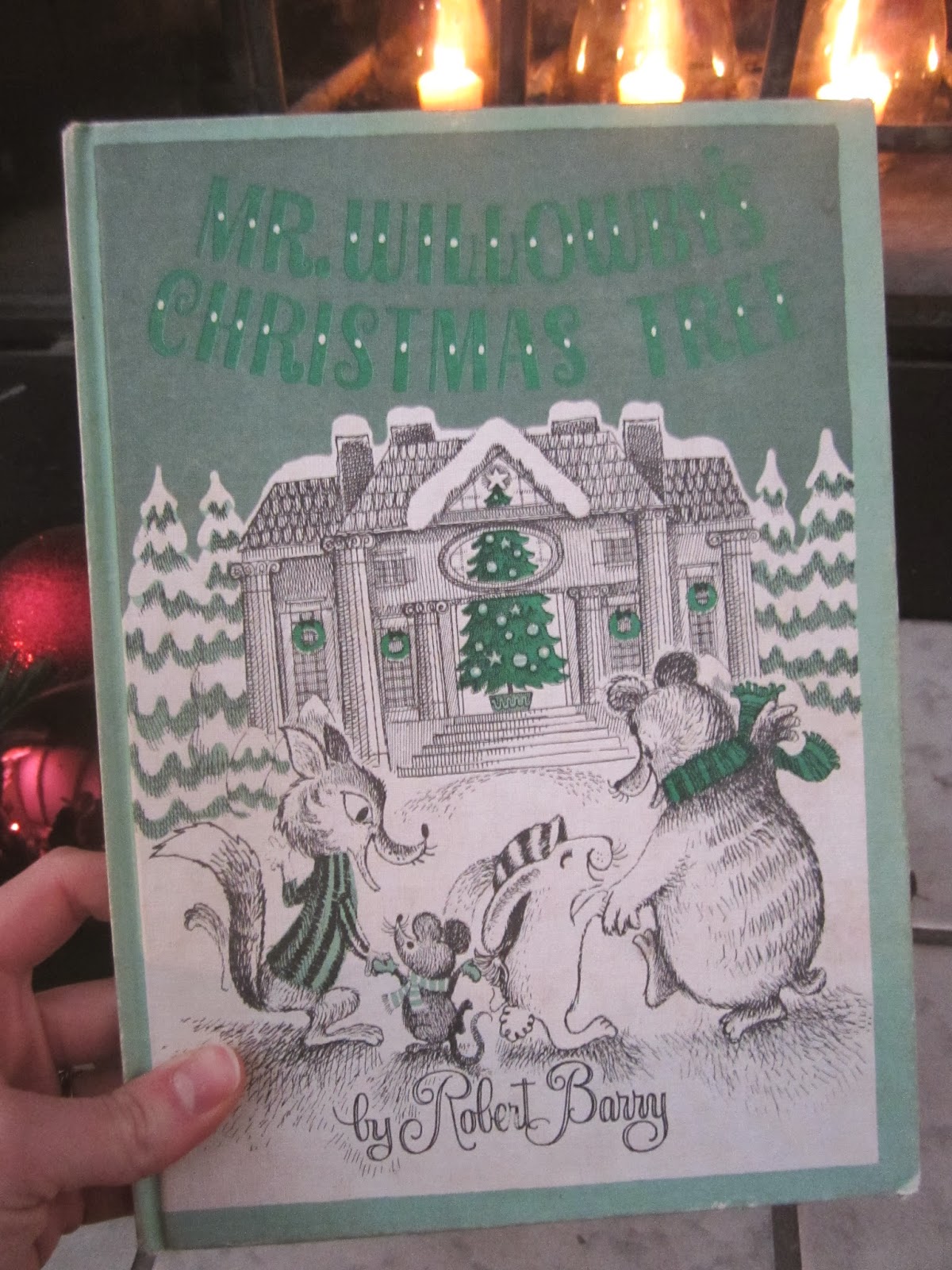
Review: Mr. Willowby's Christmas Tree by Robert Barry
The thing that makes the holidays so special is that each family has their own traditions. Many are similar to other families' traditions, but each has a bit of personal flair. Ours include baking and decorating cut-out cookies and peanut butter blossoms, going ice skating, sisters caroling at the piano, arranging Christmas tunes for our various musical instruments, watching White Christmas and classic Christmas cartoons recorded in 1989 on VHS. We also read Mr. Willowby's Christmas Tree aloud every year. Published in 1963, my grandma first read it to my mom and uncle, and then my grandma would read it to me when I went to her house. Now we have the beloved book at my mom's house, and last night my sister Jessica read it aloud to the family.
The sweet story of Christmas unity and sharing is told in rhyme and begins with one large Christmas tree. Mr. Willowby quickly realizes that it is just a little too large for his parlor. The solution is to chop off the tippy top. Instead of throwing it out, the top is sent to Mr. Willowby's maid, who finds the tiny tree to be perfect for her apartment. Well, almost perfect. After a snip off the top, the tree looks great. Tim the gardener finds the discarded top, and it keeps going until all the little forest families have progressively smaller trees just as festive as Mr. Willowby's.
This special childhood story will remain a little part of our Christmas for a long time. I can't wait to read it to my own kids.
What are some of your favorite Christmas traditions? Any of them literary? I'd love to hear about them!
Follow my blog with Bloglovin
Saturday, November 16, 2013
Review: The Aviator's Wife by Melanie Benjamin
About a month ago, I picked up The Aviator's Wife from the shelves that house the recently returned items at the library for which I work. This morning I finally finished the novel. It was the fourth or fifth time the book had been on the returned shelf, a good sign, and since I have been leisurely working my way through Anne Morrow Lindbergh's Gift from the Sea, I thought it would be fun to read an author's interpretation of the relationship between Charles Lindbergh and his wife. I really didn't know much about either icon before reading this, so I enjoyed the little history lesson Melanie Benjamin provided. It was an easy read with a touching ending.
To put it bluntly, however, this book was an overall disappointment. Having read over half of Gift from the Sea, I was upset to find Benjamin's portrayal of Anne Morrow Lindbergh as a weak, submissive wife throughout the entire novel. After reading the author's notes, I realized that belittling Anne and making her Charles' well-trained puppy was not even Benjamin's intentions. She meant to show the world the strong, resilient Anne who made the Lindberghs the lovable couple many people remember them as now. Benjamin failed at this goal. It was hard to plow through the middle half of the book because the poor heroine was a broken record in her thoughts and actions, so you become bored and irritated with the mousy housewife who is herself bored and lonely with a total lack of confidence. Instead of emphasizing her bravery, as the author's notes claim was the purpose, Benjamin makes every courageous act something Anne had no choice in and would never have done without Charles' insistence, such as becoming the first American woman to pilot a glider plane. The novel only mentions one of Anne Lindbergh's works, Gift from the Sea, and makes it seem that it was written mainly to get back at Charles for writing a well-received memoir of his famous Paris flight. Benjamin did emphasize Anne's exceptional aviation skills and years as co-pilot to her husband, which was truly an accomplishment, but the author entirely underplays Anne's literary career, mostly by ignoring it.
The "Anne" in Gift from the Sea is a calm, wise beacon of inspiration for women both then and now. Benjamin's "Anne" is a vessel of wasted talent and potential, at the beck and call of the famous aviation hero. It was painful to have someone as admirable as Anne Morrow Lindbergh portrayed in such a way.
If you want to learn about the Lindberghs, I would suggest reading Anne's diaries, Gift from the Sea or Charles Lindbergh's The Spirit of St. Louis and come to your own conclusions about the couple's extraordinary lives and relationship.
Monday, November 4, 2013
Review: The Bell Jar by Sylvia Plath
It is1953,
the summer before Esther’s senior year as an English honors student at an Ivy
League all-girls’ college. She, as a
skilled poet, artful writer, and top student, earns a month-long summer
internship for a young ladies’ magazine in New York City. It seems that Esther has everything going for
her: a prestigious scholarship to a top college, a medical school beau, and a
glittering internship. In NYC, however,
questions arise within Esther that she cannot answer, daunting questions about
her future, her life after the internship, after the summer, after graduation. They begin to eat away at her spirit and
morale. She could marry someone, perhaps
Buddy Willard the med student, and clean his house, have his babies, and make
his dinners. Or she could pursue any
number of professional interests such as author, professor, editor, or
explorer. She is frustrated that she must
choose only one and give up the other option. Her inability to choose one direction and
forget the rest is a source of crippling anxiety. The uncertainty of her own future terrifies
this over-achieving young woman. When
Esther returns home from New York to await the start of the fall semester, her
anxiety turns to apathy before spiraling into a deep and destructive depression.
The reason
this highly personal, highly autobiographical novel is viewed as more than a lost
college girl’s diary entries written almost 20 years later is obvious. Along with touching on themes of purity and
sexuality, the feminist classic is a clear portrait of the tough choices young
women faced not just in the 50s but for the past 60 or 70 years. Any girl at a crossroads in her life would be
struck by Plath’s ability to pinpoint the reader’s own personal fears about innocence,
sexuality, marriage, education, and careers through Esther’s story. The feminist struggle between family and career
are debated from the perspective of someone with the beginning of this struggle
on her horizon.
One passage
that exposes the stress college and even high school girls felt 60 years ago
and still feel today gripped me with its imagery and its relativity to my own
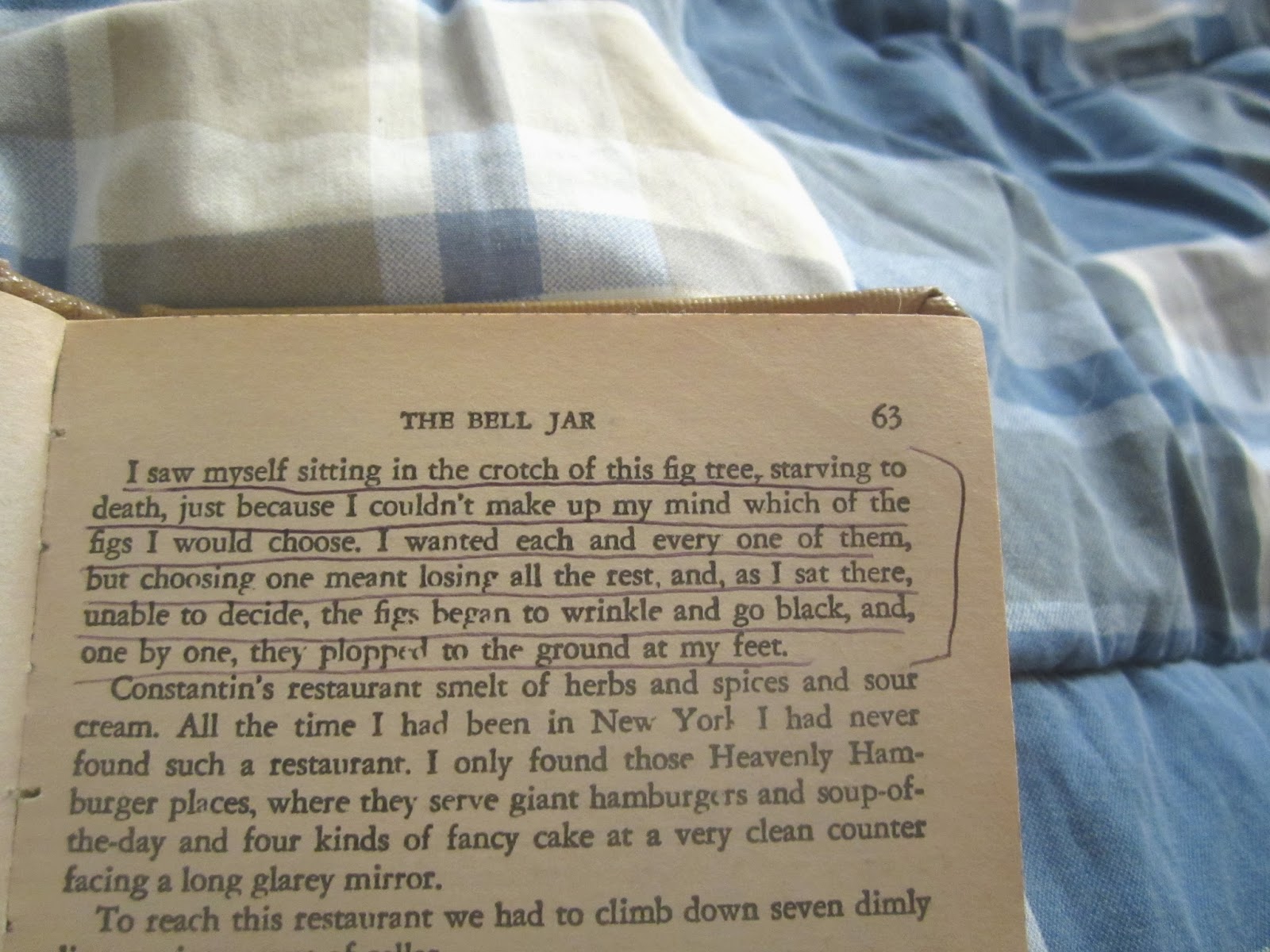
life. Esther says she sees her life
branching out like a fig tree, and each fig is a different future she could
pluck and bite into.
| For the record, I did not mark in this library book! :) The passage had already been underlined. What kind of library worker would I be if I wrote in borrowed books? |
The fig
tree appears earlier in the novel when Esther opens an anthology of short
stories to find one about a Jewish man and a Catholic nun meeting under a fig
tree. The fig tree in the Bible is said
to symbol prosperity, security, and peace, which are things Esther longs for, but
she doesn't know which fig seems best suited to bring her happy security.
Sylvia
Plath’s novel and writing style is blunt and haunting. I
read it over the summer, which turned out to be long, dull, and lonely for me,
so I was a bit frightened when the beginning of the novel truly resonated with
me. Esther starts at sad and confused
and slides along the depression continuum. Further into the book when I found I no longer shared her same thoughts or agreed with her plans to hurt herself, relief spread through me. I’m not
sure if I would recommend this book as a remedy for depressive moods, but it did show me that I wasn’t alone in my helpless frustration and indecision. While I appreciated the novel's strong themes
of purity and awakened sexuality and could talk about them for ages and pages,
the idea that stays with me months later is the fig tree. The Bell Jar and its fig tree imagery gave me strange
comfort and even while it left me haunted and intrigued by Plath and her own tumultuous
life.
Have you read The Bell Jar? Did you like it? How did it affect you?
Subscribe to:
Posts (Atom)